Hydrology BC ENV 3025
HYDROLOGY - Homework # 7
1) (36 points) Water Balance of the
1993
Midwest Flood (excercise after David R. Maidment and Pawel
Mizgalewicz,
University of Texas at Austin)
Introduction
In 1993, the Midwestern States of the United States suffered their
worst
flood in more than 40 years. Heavy rains sustained throughout the
summer
flooded Iowa and portions of surrounding States. President Clinton
appointed
a team called the Scientific Assessment and Strategy Team (SAST) to
examine
the flood events, collect and analyze data, and report on the policy
implications
of the flood. How could the effects of future floods of this type be
mitigated
through policy changes? Should levees that breached in the flood be
rebuilt?
Has the draining of wetlands in the Midwest created flood hazards
downstream?
If so, what effect would recreating some of these wetlands have on
flood
discharges?
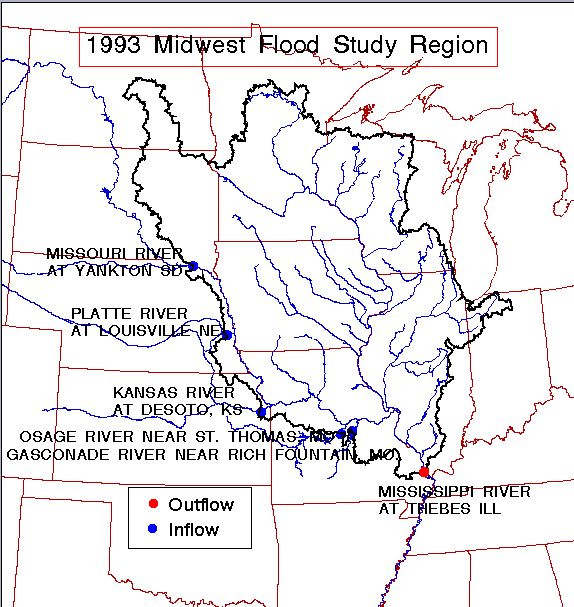
The SAST team met and worked for several months at the US Geological
Survey's EROS Data Center where they compiled a considerable volume of
data, some of it displayed on the SAST
Home
Page. In February, 1994, the SAST team convened a meeting of
hydrologists
and hydraulic engineers from around the United States to review the
team's
work and to suggest new lines of activity. It was fairly clear at this
meeting that hydrologic practice at the time could not address very
well
the huge regional scope of the flood: the affected region has an area
of
approximately 700,000 km2, and most of the studies presented
at the meeting dealt with areas of the order of 10 to 100 km2.
At this meeting, Dr Maidment proposed that a daily water balance
study
should be carried out to look in a spatially distributed way at the
amount
of precipitation, evaporation, change in storage, inflow and outflow of
water in the region. This study was eventually funded by the US
Geological
Survey and jointly undertaken by the Center for Research in Water
Resources
of the University of Texas at Austin, and the Department of Geography
of
the University of Utah. Its methods and preliminary results can be
reviewed
on the SAST
Water
Balance Page.
This exercise is based on some of the data generated in that study.
The data presented here are for the SAST region taken as a single unit,
comprising all the drainage area of the Upper Mississippi River and a
portion
of the Missouri River drainage, primarily capturing westward flowing
water
from Western Iowa. There are five inflow points to the study region
where
flow coming into the Missouri River from Eastward flowing tributaries
enters
the region. There is one outflow point, the Mississippi River at
Thebes,
Illinois, just above the confluence of the Mississippi and Ohio Rivers.
All inflows and outflow points are monitored by USGS gages reporting
daily
discharge.
Daily precipitation over the region is estimated by interpolation
from
records of more than 1000 gages. Daily evaporation over the region is
estimated
by taking National Weather Service Maps of potential evaporation, and
finding
the factor (0.775) which when used to multiply the potential
evaporation
ensures that the annual water balance from January 1 to December 31,
1993,
is approximately closed.
Goals of the Exercise
- To provide experience in analyzing the water balance of a large
region
- To practice using spreadsheet programs for hydrology
- To learn something about the 1993 Midwest flood.
Computer and Data Requirements
Dowload the water balance data: Comma-delimited text file: midwest.csv
The data consist of:
Column 1: Date (month/day/year)
Column 2: Outflow [m3/s] from the region (discharge
measured in the Mississippi R. at Thebes, IL.)
Column 3-7: Inflow [m3/s] into the region measured
at five sites where rivers drain into the study region from the West:
- Osage River near St Thomas, Missouri
- Gasconade River near Rich Fountain, Missouri
- Missouri River at Yankton, South Dakota (the discharge from the
upper
Missouri
basin which enters the study region)
- Platte River at Louisville, Nebraska
- Kansas River at DeSoto, Kansas
Column 8: Average Precipitation over the Region[mm/d]
Column 9: Average Evapotranspiration over the Region[mm/d]
Drainage area within the study boundary = 698525 km2
Conversion factors:
1 d = 86400 s
1 m = 1000 mm
1 km = 1000 m = 1,000,000 mm
1 cfs = 0.028317 m3/s
1 in = 2.54 cm
1 m = 3.2808 ft
Procedure
The daily water balance is to be constructed for 365 days, 1 January to
31 December 1993.
- Convert the outflow series of the Mississippi River at Thebes,
Ill,
into
a series of equivalent depths in mm/day by converting the daily
discharge
into an equivalent volume in m3/day and then dividing by the
drainage area.
- Aggregate the five inflow series into a single total inflow
series and
similarly convert the total to an equivalent depth of water in mm/day
by
dividing by the drainage area.
- Construct a spreadsheet with date in the first column and the
succeeding
four columns being precipitation, evaporation, inflow and outflow, all
in mm/day. To make a date field in Excel, type 1/1/93 in the first
column,
use a formula to add 1 to get the date in the next row in this column,
then copy the result to succeeding rows.
- Add two additional columns, the change in storage each day
computed as:
Change in Storage = Precip - Evap + Inflow - Outflow
and the total accumulated storage in the region, assuming that
the
storage was initially 30mm on 1 January 1993.
The result should look something like this:

- Determine the annual total precipitation, evaporation, inflow,
outflow
and change in storage for the region. Is the annual water balance
reasonably
closed?
- Plot a graph showing the outflow in mm/day and the storage in mm
against
the date. Prepare the graph in the usual way in Excel and then click on
the outflow line once the graph is plotted, bring up a dialog box,
click
on "axis" and select "secondary" to get both the outflow and the
storage
plotted with different y axes.
The result should look something like this:
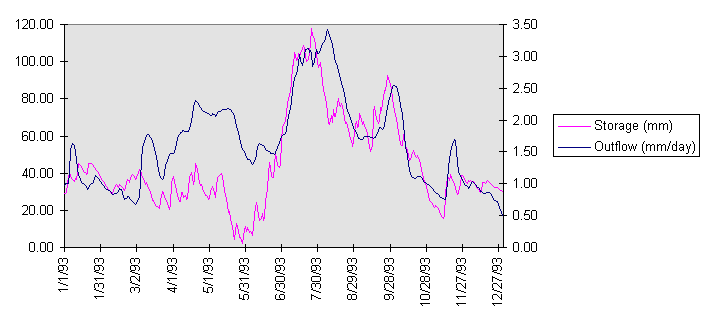
- It appears that the bulk of the flood occured over a two month
period from
1 July to 31 August 1993. Prepare a new spreadsheet for this period.
Determine
the series (precipitation - evaporation) and (outflow - inflow), all in
mm/day and plot them. The result should look something like this:

RESULTS TO BE TURNED IN:
- (8 points) The total annual precipitation, evaporation,
inflow,
and outflow in mm for 1993. What is the annual net outflow (outflow -
inflow)
in mm? What percentage of the annual precipitation within the region
evaporated
and what percentage drained out of the region in the Mississippi River?
- (8 points) A graph showing the storage (mm) and the
discharge (mm/day)
for the period Jan 1 to December 31, 1993. What was the peak depth of
storage
on the land surface? When did it occur? What was the peak discharge
(mm/day
and m3/s) at the outflow point? When did it occur? What was the lag
time
between the peak storage and the peak discharge?
- (8 points) Present a spreadsheet showing the daily water
balance
analysis for July and August 1993. This should include date,
precipitation,
evaporation, inflow, outflow, change in storage and storage, in mm.
Plot
a graph showing (precipitation - evaporation) and (outflow - inflow).
What
effect does flow through the region have on smoothing the time
variations
in precipitation?
- (8 points) For this two month period, what was the total
precipitation,
evaporation, inflow, outflow and change in storage in mm? What was the
net outflow (outflow - inflow) in mm? What percentage of the
precipitation
left the region as evaporation? What percentage of the precipitation
flowed
out of the region as net outflow?
(4 points) Do something interesting with the data that has not
been requested as part of this exercise. Analyse some aspect of this
problem
and present a brief description of what you have determined.