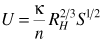
we need to know some background regarding flow in channels,
because of the following questions:
How are water depth and discharge in a stream related?
How does the velocity in a stream change as the amount of
water carried by the stream increases?
streams are different from pipes because they do not have a
lid!
streamline: a path defined by the motion of
fluid elements in a flow; at any point along a streamline, the
flow direction is tangent to the streamline. Conceptually, water
may not cross streamlines. The density of streamlines is
proportional to the flow velocity.
Specific Energy
Bernoulli equation is a good starting point, although it is
dealing with a frictionless fluid; over short distances no
friction can be assumed
recall the Bernoulli equation, for a frictionless fluid,
for horizontal flow the velocity is the same everywhere
(=average velocity); also we can assume that the pressure will
follow the hydrostatic equation, p=
ρ*g*d,
then
we can simplify the equation by: U2/(2*g) + h +zb
= H, U being the average flow velocity (Fig4.2)
the first two terms are the specific
energy: U2/(2*g) + h = E, the dimension of
E is [L]!
by inserting Q=U*h*w (w is width of stream), we are getting Q2/(2*g*w2*h2)+h=E
for a certain discharge rate of the stream, we can plot depth
of the stream versus its specific energy: there are two depths
possible for each value of specific energy! (Fig4.3)
supercritical, subcritical flow and
hydraulic jump (Fig. 5.6)
for open channels and using 4*the hydraulic radius for the
diameter D, the transition between laminar and turbulent flow
occurs at the same range of Reynolds numbers (between 2300 and
4000)
velocity distribution as a function of
depth (Fig4.10), most
flow is turbulent, average flow velocity is at a depth of
0.6*total depth
Measuring flow in natural channels
weirs can be used to measure discharge
rates as we did in the lab
we can look impirically at the
discharrge rate vs. height relationship for a stream without a
well-defined weir and can can use this to estimate the
discharge rate (Fig4.13, for
this particular creek the exponent in the empirical
relationship between Q and h is 2.85).
schematic diagram of a stream gaging
station (Fig5.2)
velocity distribution as a function of
depth (Fig4.10), most
flow is turbulent, average flow velocity is at a depth of
0.6*total depth
we can measure the discharge rate by
taking measurements at 0.6* depth (from surface) wading
through the river (Fig4.11)