Hydrology EESC BC 3025
Atmospheric
moisture, condensation, and precipitation
Moisture in the atmosphere
- water undergoes huge expansion during evaporation: 1 g of
water equals 1 ml volume in liquid form and 42 l as vapor (at 25oC)
- gravity concentrates the atmospheric gases near the surface,
the pressure drops to 1/e (= 37%) at about 8 km
elevation
- 90% of water vapor content is confined to the lower 6 km
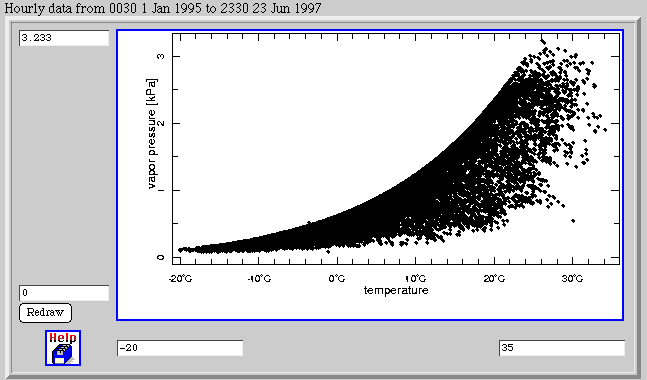
- water vapor pressure as a function of temperature (svp
= saturation water vapor pressure) (Fig), can explain many
phenomena in the atmosphere.
- absolute humidity (or water vapor mixing ratio):
mass
of vapor per unit volume of air, in g m-3
- at 30oC, air has a svp of 42.43 hPa (hPa = mbar)
and can contain up to 30 g m-3, at 0oC
svp is only 4.5 g m-3
- relative humidity: actual water vapor pressure / svp
in %; or: actual water vapor content / water vapor content at
saturation
- formation of fog, clouds,
mixing clouds, can be understood in the framework of the vapor
pressure diagram
Condensation and Precipitation
condensation:
- transition from vapor phase to liquid phase
precipitation:
- deposition of liquid water droplets and ice particles that are
formed in the atmosphere and grow to a sufficient size so that
they are returned to the Earth's surface by gravitational
settling. Solid and liquid. Dew and fog do not count as
precipitation (can add 5-10% to precipitation in the Pacific
Northwest)
clouds and precipitation
explanantion of processes through the vapor pressure diagram
(Fig): air rising =>
expansion => adiabatical (= no heat exchange with
environment) cooling => condensation
example: humidity and temperature for Black Rock Forest (Fig)
at T>0oC: warm
cloud process: condensation, gradual growth of water
droplets by condensation, collision and coalescence
at T<0oC: cold
cloud process: involves also the formation and growth
of ice crystals (Fig)
two extra factors are needed to form
precipitation:
- sufficient moisture supply
- sufficient vertical motion
warm cloud process
- a moisture laiden air parcel rises,
cools at dry adiabatic lapse rate (~1oC/100m)
until it reaches the dewpoint, at which point
condensation occurs. After that, any further rise causes
cooling at the moist adiabatic lapse rate (0.5 -
0.9oC/100m), because of the released latent heat.
(Fig)
- super saturation: relative
humidity > 100%
- condensation nuclei are
needed to increase condensation
- most efficient particles: Aitken
nuclei
(0.01-0.1 micro m)
- typical source: dust from land,
sea spray (hygroscopic!)
- 5 million/l air over land, 1
million/l air over the ocean
- experiment:
salt crystals as condensation nuclei (Fig)
- experiment: when a beer
bottle is opened, a cloud forms in the neck. If temp. of the
bottle is 5oC, temperature drops to ~-36oC
when bottle is opened (Fig)
- experiment: when beer is
pored into a glass, bubbles form on scratches and dust
particles, adding salt can increase the bubble formation: clouds
in a glass of beer
- excercise: condensation
on
a
mirror
in the bathroom (Fig);
condensation on windshields
- condensation only creates droplets
< 100 micro m radius, while raindrops are of the order of
1mm
- clouds are continuously forming and dissipating, some live
only 5 to 15 minutes
- excercise: how
many cloud droplets form one rain drop?
- droplets merge due to direct impact
and collision in the wake of falling drops
cold cloud process
- saturation vapor pressure is lower
over ice than water => ice crystals grow in favor of
liquid droplets
- ice crystals are very efficient
condensation nuclei
- most efficient in mid latitudes
(temperatures low enough, but enough instability in the
atmosphere)
Precipitation patterns
- kinds of precipitation: drizzle, rain,
ice pellets, snow, hail
- terminal velocity (v) is
achieved when gravitational acceleration is counterbalanced by
the friction of the air, for 1mm diameter drop: v = 4
m/s = 9 miles/hour
- raindrops break up at 5 mm diameter,
snow flakes can reach 40mm, and hailstones over 50mm
- moisture in atmosphere: 25% condenses,
75% forms ice and snow; only 5% of that falls as snow and ice
crystals, the rest melts; a lot of the precipitation
re-evaporates before it reaches the ground
- most precipitation comes from bordering oceans, but up to 40%
can come from local ET.
- extremes in US: Kauai: 12,000 mm/y, Death Valley: 40mm/y
- dryest place on Earth: Calama in Atacama desert, Chile, rain
has never been recorded
- average annual precipitation (global (Fig) and US (Fig)) onto
the continents is a function of:
- (a) latitude (precipitation highest in latitudes of rising
air-0° and 60° north and south-and lowest in latitudes
of descending air- 30° and 90° north and south);
- global circulation patterns in the
atmosphere (Fig)
- (b) elevation (due to orographic cooling, precipitation
usually increases with elevation (Fig) ;
- (c) distance from moisture sources (precipitation is usually
lower at greater distances from the ocean);
- (d) position within the continental land mass;
- (e) prevailing wind direction;
- global circulation patterns in the
atmosphere (Fig)
- (f) relation to mountain ranges (windward sides typically
cloudy and rainy, with leeward sides typically dry and sunny)
- (g) relative temperatures of land and bordering oceans
- global circulation patterns in the oceans (Fig)
- exercise:
spatial and temporal variability of precipitation
Point measurements of precipitation
- Obviously precipitation data are extremely important in
hydrology
- need to measure at many points and need to extrapolate
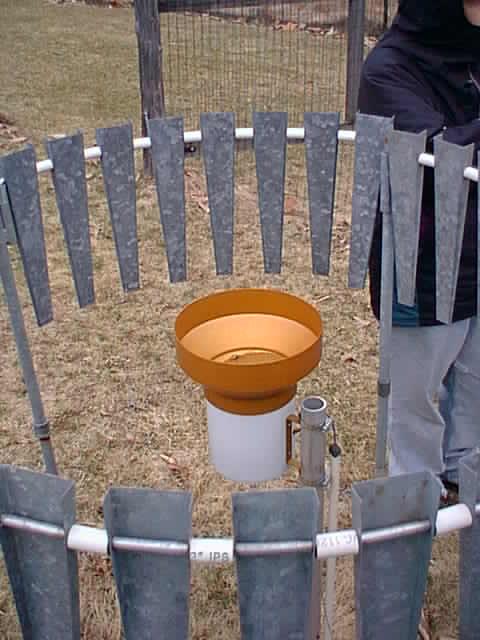
- point measurements performed by recording and non-recording
gages
- snow depth measurements by telemetry, 500 remote sites in US
- precipitation typically measured as depth
- many stations all over the world (Fig)
- the record of hourly precipitation over time is called a hyetograph
and shows that precipitation is organized into discrete storms (Figure 2.3, a
station in North Carolina)
Resources