a moisture laiden air parcel rises,
cools at dry adiabatic lapse rate (~1oC/100m)
(= no heat
exchange with
environment) until it reaches the dewpoint,
at which point condensation occurs. After that, any
further rise causes cooling at the moist adiabatic lapse
rate (0.5 - 0.9oC/100m), because of the
released latent heat. (Fig).
Spatial characteristics of precipitation and radar estimation
averaging over an area using point measurements at stations (Fig2.4)
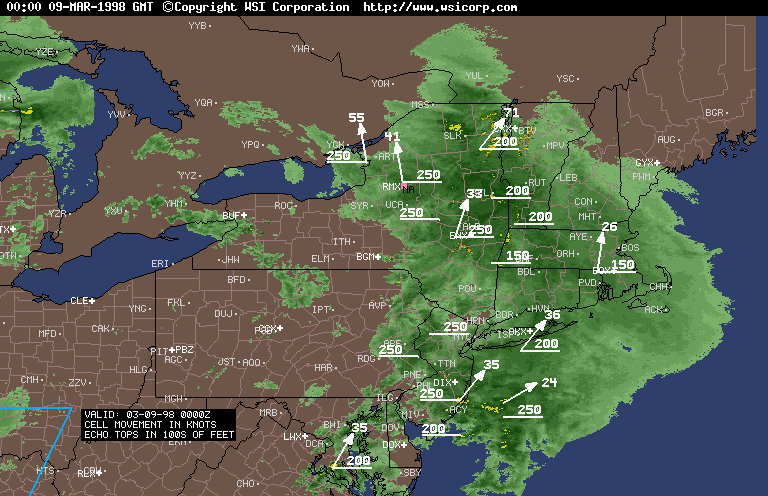
measurement by radar, radar is reflected from raindrops
storm track and total rainfall accumulation during a storm
on June 27, 1995 based on radar measurements (Fig2.5)
the record of hourly precipitation over time is called a hyetograph
and shows that precipitation is organized into discrete storms (Figure
2.3, a station in North Carolina)
our ability to forecast this temporal variation even a few
hours in advance is
limited and our ability to forecast several days in advance is
almost zero
if you examined all of the rainfall data for a given region,
you would find an upper limit to
hydrologists apply a technique called frequency analysis
to describe the temporal characteristics of precipitation
we assume that precipitation data are samples of a random
variable characterized by a probablility density
function
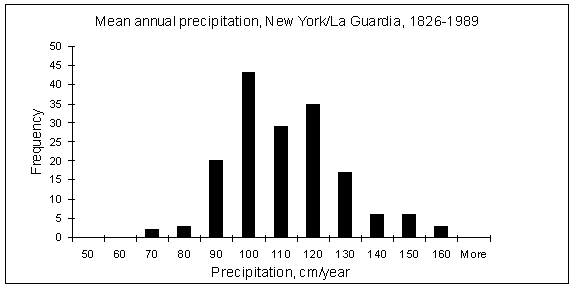
only mean annual precipitation appears to be normally
(or Gaussian) distributed (Fig2.7)
if normally distributed, precipitation can be described by a mean
and and a standard deviation (Fig2.6)
this information is useful to determine the exceedence
probability (the probability that a certain annual
precipitation value is exceeded in a given year) or the
return period (the inverse of the exceedence probability).
If data are normal distributed, EXCEL's NORMINV
function can be used to determine the value of a particular
parameter (e.g. annual precipitation) for a particular
exceedence probability and recurrence interval
determination
of
exceedence probablity using standard deviation, mean and the
normal distribution. Use LGA/NY as an example (Fig2.6).
calculate the precipitation
that is exceeded in the wettest 10% and 1% of years
Evapotranspiration
Interception
process by which precipitation falls on vegetative surfaces
(the
canopy),
where it is subject to evaporation (Fig2.8)
stemflow (flow along the stem), throughfall
(the
precip that
has avoided interception or dripped off the canopy)
effects of different kinds of vegetation on capacity and
runoff (Fig)
afforestation could increase evaporation losses by up to 50 to
100%,
clearcutting
increases runoff
Evapotranspiration
evapotranspiration summarizes all processes that return liquid
water
back
into water vapor
water needed and solar energy
of the water taken up by plants, ~95% is returned to the
atmosphere
through
their stomata (Fig)
potential evaporation
(PE),
i.e.
the
evaporation rate given an unrestricted water supply -
different from
actual
evaporation
how can the actual evapotranspiration
be
measured?
water balance
energy balance
or combination of both
Estimation of ET from the water balance
this approach may suffer from the
uncertainties in
the numbers, example:
p = 107+/- 5 *105 m3/y
rsi = 109 +/- 1.5*108
m3/y
rso = 9.95*108 +/-
1.5*108
m3/y
ET = p + rsi - rso
Estimation of ET from the energy balance
A control volume for energy conservation (Fig2.9),
R: solar energy in, H: sensible heat flux out, El: latent
heat
flux
out, G: sensible heat flux into ground
the energy balance for the control volume: dQ/dt = Rn-G-H-El
et = El / (
ρwλv)
if G, H, and changes in Q over time can be neglected:
et = Rn/ρwλv =
200 Wm-2 / (1000 kg m-3 * 2.5 106
J kg-1)
=
0.7 cm day -1
in many case, we cannot neglet all the other energy fluxes,
see
for
example
measured energy fluxes for a field in CA (Fig
2.10)
it is not easy to measure the fluxes in the real world, Eddy
Covariance
measurements measures vapor pressure and vertical windspeed
there are lots of empirical equation describing
evapotranspiration,
example
the Penman equation or combination
equation
(Fig)
E higher over oceans than land (except
for
areas
covered by sea ice) (Fig)
E increases with temperature
oasis effect
The Atlantic Ocean is loosing water by evaporation (Fig),
this loss is balanced by transport of ocean water from the
Pacific
ocean
(1 Sverdrup = 106 m3 s-1,
equivalent
to
the discharge rate of all rivers on Earth)