| Week |
Date | spring/fall seq. (1st sem) | fall/spring seq. (2nd sem) |
|---|---|---|---|
| 1 |
Jan. 23, 4:10-6:00 530 Altschul |
530: Introductions, courseworks, website, emails, announcements (MS) | |
| 805:
Goals
of
Senior
Seminar, grading policy (MP), signup (MM),
career speaker suggestions (MP), scientific
writing (JK), What
makes a good thesis project (MP), Advisor/mentor/student
relationship (JK), Peer
review process
(MM) |
530: Course overview, signup, grading policy
(MS), Statistics/data
analyses questions (MS); Career speaker
suggestions (MS); Senior thesis versus
scientific journal article (SM);
common issues with proposals (MS) |
||
| 2 |
Jan. 30,
no class |
Individual
meetings with advisors and mentors to discuss thesis topic,
no class |
Individual
meetings with advisors and mentors discussion of
thesis proposal, no class |
| 3 |
Feb. 6,
no class |
Individual meetings with advisors and mentors to discuss thesis topic, no class | Individual
meetings with advisors and mentors
discussion of thesis, no class |
| 4 |
Feb. 13, 4:10-6:00 805 & 530 Altschul |
805:
Outline (MS), Discussion of
assigned thesis proposal, IRB
(JK),
Plagiarism (SM),
How
to write an introduction (EC), Peer
review groups (MS), Concept
maps (LB)
Individual meetings with advisors and mentors to discuss thesis topic Due: Read assigned thesis proposal |
530:
Statistics and Data Analysis
Salon (optional)
(MP,RC) Individual meetings with advisors and mentors discussion of thesis |
| 5 |
Feb. 20,
4:10-6:00 530 & 805 Altschul |
530: Methods of library
research,
ISI
Web
of Science (SM),
Discussion of
concept maps (EC) Individual meetings with advisors and mentors to discuss thesis topic Due: Concept map of your introduction |
805: Statistics and Data Analysis
Salon, R (optional)
(RC) Individual meetings with advisors and mentors discussion of thesis |
| 6 |
Feb. 27, 4:10-6:00 405 Milbank |
Careers, Funding opportunities for senior thesis work (e.g. travel) (EC, EL) | |
| Due: Outline of thesis proposal, incl 10 references (1 copy) | Due: 1st draft of thesis (1 copy) | ||
| 7 |
Mar. 5, 4:10-6:00 805 & 530 Altschul |
||
| Individual
meetings with advisors and mentors
discussion of thesis proposal outline, no class |
530: How
to make a poster (TBA),
30
second slides, (TBA) Individual meetings with advisors and mentors discussion of thesis draft |
||
| 8 |
Mar. 12, 4:10-6:00 on-line, see announcements |
805:
How
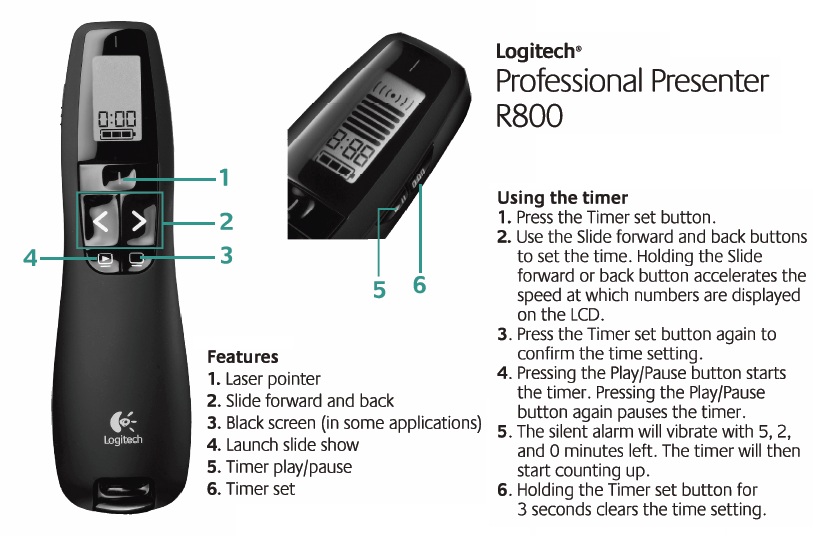
to give a scientific talk
(SH,RC) PPT & other tech. issues, remote (MS), Results, figures & captions (MM), Individual meetings with advisors and mentors Due: |
530: Figures and Graphs Salon (optional) (SM) Individual meetings with advisors and mentors discussion of thesis draft |
| 9 |
Mar. 19,
no class |
SPRING
BREAK! |
|
| 10 |
Mar. 26, 4:10-6:00 on-line, see announcements |
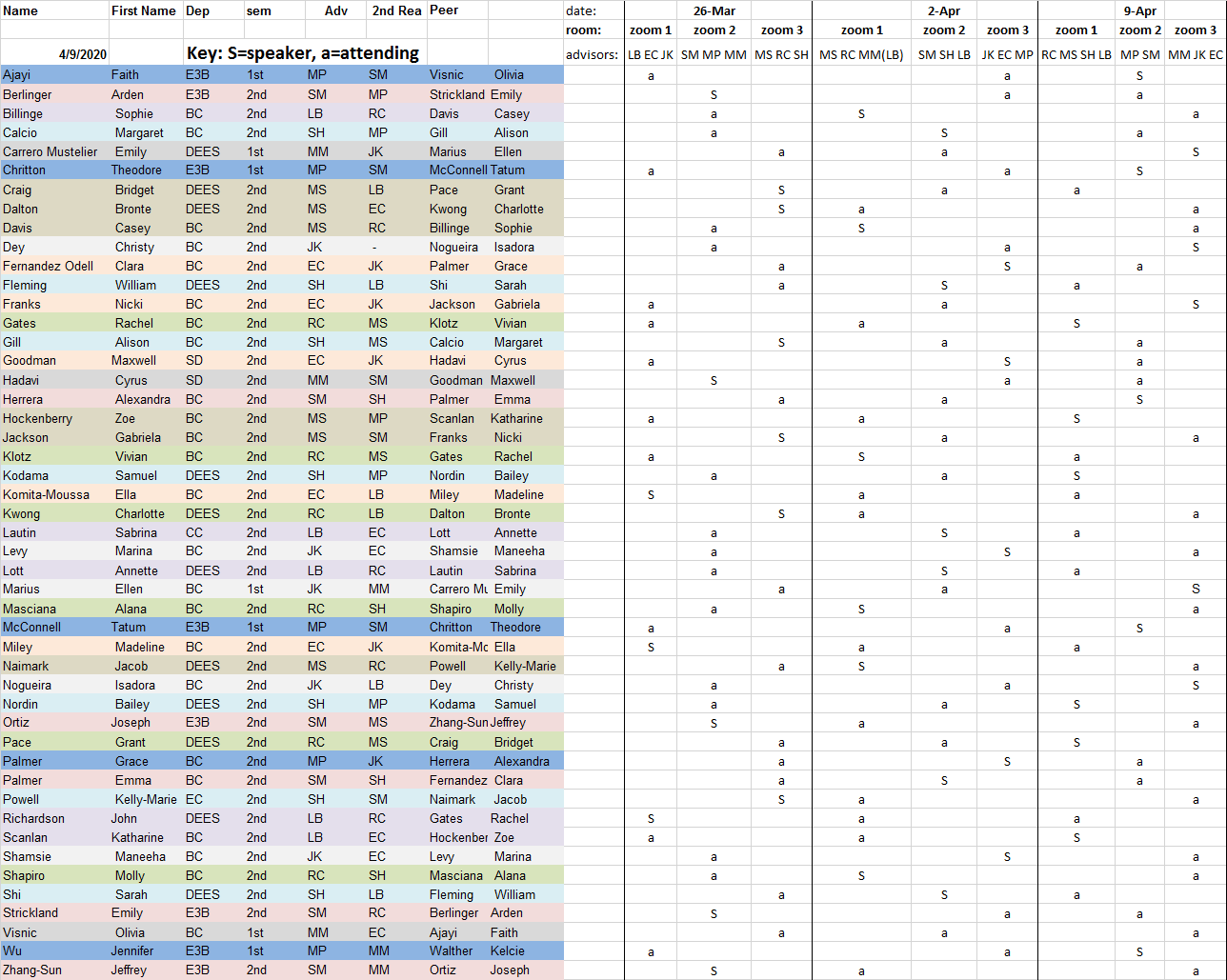
Mini-conference
1, 10min presentations
plus 3min discussion (see student
list for time assignment) |
|
| Mar. 26 | |||
| 11 | Apr. 2, 4:10-6:00 on-line, see announcements |
Mini-conference
2, 10min presentations
plus 3min discussion (see student
list for time & peer
assignment) Individual meetings with seminar faculty and mentors, discuss poster, final thesis/proposal, look at examples of thesis proposals and theses |
|
| Due: thesis proposal draft, 2 copies, begin of peer review process | Due: 2nd draft of thesis, 3 copies, begin of peer review process | ||
| 12 |
Apr. 9, 4:10-6:00 on-line, see announcements |
Mini-conference 3, 10min presentations
plus 3min discussion (see student
list for time & peer
assignment) Individual meetings with seminar faculty and mentors, discuss poster, final thesis/proposal |
|
| 13 |
Apr. 16,
4:10-6:00 on-line, see announcements |
Individual
meetings with seminar faculty and mentors,
discuss final thesis/proposal You are welcome to attend the 2nd semester session today about posters Due: copy of review sheet for your peer (Courseworks) |
Presentation
of 30s slide in class/discussion of poster drafts Due: poster drafts, 30s slide draft, discussion in class, copy of review sheet for your peer (Courseworks) |
| by Tu Apr 21, 12 noon |
Due:
deposit final narrated summary ppt slide on
courseworks, submit name/title for program |
||
| 14 |
Apr.
23, 4:30pm-7pm on-line, see announcements |
Poster
session Due: upload final poster as ppt and pdf file on courseworks(2nd semester students only) |
|
| 15 |
Apr
30, 4:10-5:30 on-line, see announcements |
Careers:
How to get ahead in Professional organizational
environments (S. Cohen?) |
|
| 16 |
Mo May 4, midnight EDT, on-line; no class | Due:
Final thesis/proposal (electronic copy on courseworks) |
|