SOUNDS OF SEISMOLOGY:
Waves near the source: an earthquake in Japan


The Niigata-Chuetsu Earthquake of July 16, 2007, Magnitude 6.6 killed about 11 people and displaced hundreds of families from their homes.
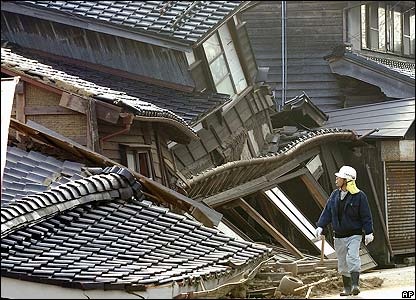
(image from Associated Press)

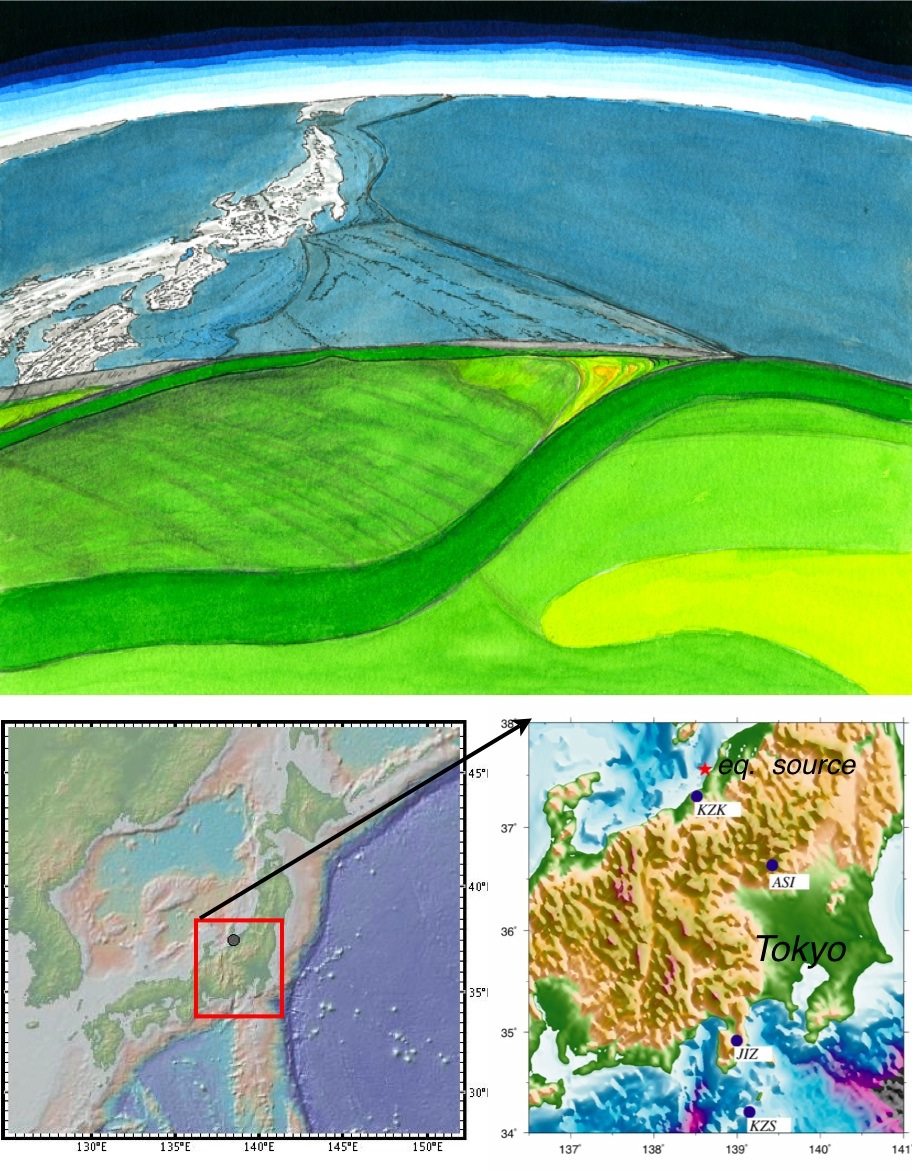
The earthquakes in Japan are due to the dynamics of the plate and mantle caused by subduction of the Pacific plate:


This movie is an animation of the data of motions of the earth's surface in Japan, the so-called "strong motion" of the ground near the source of the earthquake. These motions are the ones that destroy buildings, and are too large to be recorded by regular seismometers, so "accelerometers" must be used. The movie was made by Professor Takashi FURUMURA, Earthquake Research Institute, University of Tokyo:


Sounds of the Niigata-Chuetsu Earthquake
From HINET stations, 90 minutes of data, 100 sps


These sounds were made with the help of Motoko Ishise at the Earthquake Research Institute, University of Tokyo. The first three sounds sampled at different rates are composites from four stations (shown in the image below) and mixed in stereo, such that the motion of the waves from left to right is the motion of the waves across Japan.

2 k:

4 k:

16 k:


16 k moving:


The decay in amplitude and frequency of the waves as they move across Japan is due to the physical properties of the crust (waves attenuate) and also "dispersion" as they bounce around inside the crust.


When the waves reached Tokyo, they reverberated in the basin, and lingered there for a long time.