ONE: WHAT IS AN EARTHQUAKE ?


Earthquakes are tiny discrete events in the slow and vast dynamics of plate tectonics and mantle convection. However, to us, earthquakes are huge events, far more powerful than anything humans could create. In this section, we progress from the global scale downward. Earthquakes occur as plates move past each other. Over millions of years, these motions are smooth, but over the short geologic time scales (of our lifetimes), the movements are rough, jerky and violent. These two movies illustrate plate motion and mantle convection. The coupling between the two is here left to your imagination (but is one of the Big Questions in earth science).


This movie is part of an extraordinary long-term effort by Chris Scotese, to assemble geologic data that constraints plate motions, positions and timing through earth history. This particular movie represents the last 750 million years of plate motions, supercontinent breakup and assembly: http://www.scotese.com/

(reload page to play this movie again-- it is an animated gif)
And the mantle convects (similar to boiling), but very slowly. The following movie shows the upwelling plumes (in black) and sinking cold slabs (in white) that drive plate motions. The movie duration represents several hundred million years of mantle convection (from Dave Yuen's group at the University of Minnesota):
http://marina.geo.umn.edu/


One of the central observations that lead to plate tectonic theory is that most earthquakes occur on plate boundaries, as shown here for Central and North America:

http://svs.gsfc.nasa.gov/vis/a000000/a000100/a000155/


When we zoom in on the San Andreas Fault in California, we can see that these boundaries are defined on the surface by networks of faults that extend, oh, about 10-20 km deep into the crust, and then give way to more ductile faults and shear zones. Much research is focused on the nature of these transitions and how they interact in space and time.


The earthquake is the release of energy stored in the plate as the plates move past each other far from the fault, but the fault surface is locked. When the fault suddenly gives way and the plates lurch past each other, a great deal of energy is released on that rupture surface, as illustrated here. (source of image unknown)


You can get a feel for this process by locking your fingertips and trying to flick your fingers without letting them go. The harder you push with one hand and resist with the other, the more you feel tension in your forearms building. This is stored energy, and when your fingertips finally yield, the flick is the release of that energy, analogous to the earthquake.


Now, the primer on making sounds from seismic waves is useful here:
GO


IIb. THE WAVES NEAR THE SOURCE: A quake in Japan

The Niigata-Chuetsu Earthquake of July 16, 2007, Magnitude 6.6 killed about 11 people and displaced hundreds of families from their homes.
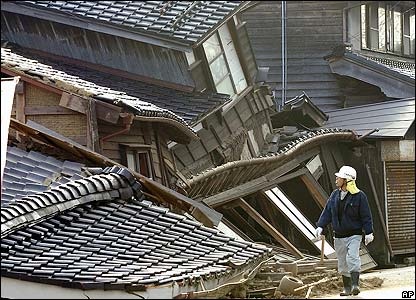
(image from Associated Press)

The earthquakes in Japan are due to the dynamics of the plate and mantle caused by subduction of the Pacific plate:
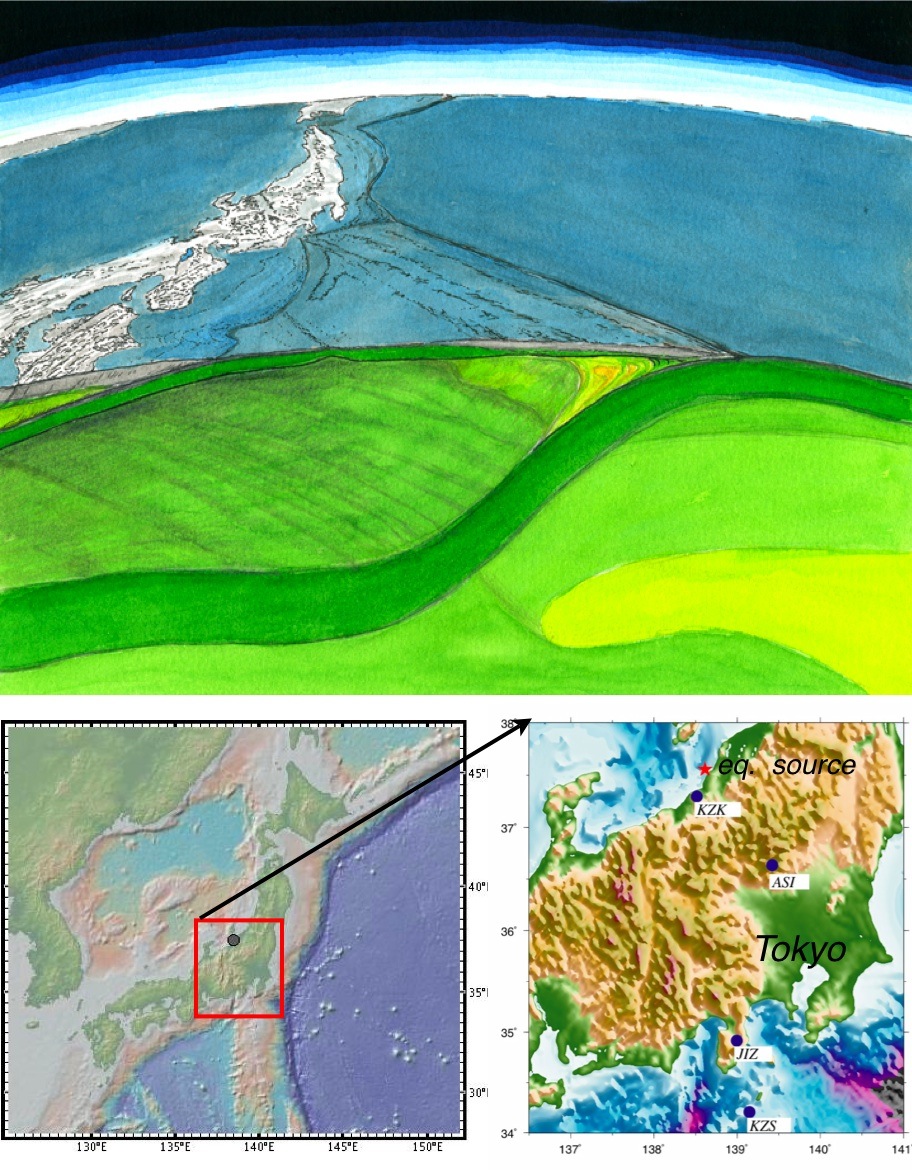


This movie is an animation of the data of motions of the earth's surface in Japan, the so-called "strong motion" of the ground near the source of the earthquake. These motions are the ones that destroy buildings, and are too large to be recorded by regular seismometers, so "accelerometers" must be used. The movie was made by Professor Takashi FURUMURA, Earthquake Research Institute, University of Tokyo:


Sounds of the Niigata-Chuetsu Earthquake
From HINET stations, 90 minutes of data, 100 sps


These sounds were made with the help of Motoko Ishise at the Earthquake Research Institute, University of Tokyo. The first three sounds sampled at different rates are composites from four stations (shown in the image below) and mixed in stereo, such that the motion of the waves from left to right is the motion of the waves across Japan.

2 k:

4 k:

16 k:


16 k moving:


The decay in amplitude and frequency of the waves as they move across Japan is due to the physical properties of the crust (waves attenuate) and also "dispersion" as they bounce around inside the crust.


When the waves reached Tokyo, they reverberated in the basin, and lingered there for a long time.


NEXT -->