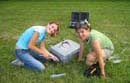
Intern:
Peggy Hannon
Project Advisors: Beate Liepert and Steve Chillrud
The visible part of air pollution
consists of small particles in the atmosphere called aerosols.
They affect the climate by scattering and absorbing solar
energy, effectively dimming the sunlight.
Measurements of atmospheric transparency taken at LDEO and
the nearby Hudson River show that there is little variation
between the two locations, despite geographical differences.
Instead, wind carries air pollution from a variety of sources
from various distances to surrounding areas.
On hazy days a large number of particles exist near the surface
--and even at 5,000 feet -- effectively dimming sunlight by
30 percent. In contrast, on a clear day the particle count
near the surface is much less, and it decreases to almost
zero at 5,000 feet. This nicely demonstrates the atmosphere’s
cleaning abilility.
Find
out more from Peggy's Final Report |
A
(not-so) typical day during Peggy's internship at LDEO:

It is Thursday afternoon, 3:30 pm.
Peggy Hannon, a Senior at Columbia University, and her mentor,
Beate Liepert, are getting ready to head to Pittstown, New
Jersey, to embark on a rather unusual field experiment: they
will ascend in a hot air balloon to about 5,000 feet, all
the while taking measurements with the instruments they are
now carefully packing into the trunk of Beate's convertible
Saab.
|