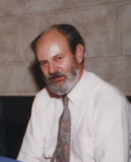
Paul G. Richards
Mellon Professor of the
Natural Sciences (emeritus)
Lamont-Doherty Earth Observatory of Columbia University
61 Route 9W, Palisades, New York 10964
e-mail to:richards@LDEO.columbia.edu Phone: (845) 365-8389 Fax: (845) 365-8150
I came to Columbia in 1971 as an assistant
professor and had a full-time academic teaching career up to 2008. Since then I have worked part-time as a
"Special Research Scientist," and am currently Principal Investigator
on projects funded by U.S. government agencies.
In grad school I
studied elastic wave propagation, earthquake physics, and Earth
structure. I was fortunate in 1975 to be asked by Kei Aki to
co-author a textbook on Quantitative Seismology. It has been
translated into Russian, Chinese, and Japanese, is still in print, and has
enabled many contacts around the world. My most exciting research
was in 1996, when Xiaodong Song and I discovered
seismological evidence that the solid inner core of the Earth, in recent
decades, has rotated eastwards a few tenths of a degree per year with respect
to the mantle and crust. The inner core is roughly the size of the
Moon, and sixty times nearer to us. For it to be moving at a rate
perceptible on human time scales, is remarkable. I described this
work in a Jeffreys lecture, given to the Royal Astronomical
Society.
I chaired the Department of Geological Sciences
at Columbia (1979 to 1983), long before it became the Department of Earth and
Environmental Sciences and part of the Earth Institute. In 1984 I took a national service leave
from Columbia to work in Washington for twelve months, and joined the unit that
wrote President Reagan's Report to the Congress on Soviet Noncompliance with
Arms Control Agreements. It was fascinating in mid-career to begin
to interact with worlds of which I had known very little---the military, the
monitoring agencies, the labs that design and engineer nuclear weapons, the
policy agencies, and people on Capitol Hill. I was asked to evaluate
claims that the Soviet Union had carried out underground nuclear explosions
with yields larger that the 150 kiloton limit
specified by the bilateral Threshold Test Ban Treaty. (Claims that the
U.S.S.R. had tested up at the 400 to 600 kiloton level, turned out to be
invalid. I have a book chapter on
part of this experience, published
thirty years later, which gets into ethical issues arising in the development
of policies that have a strong technical component.)
In the mid-1990s in the Clinton administration I
went back to Washington for another year's national service leave from
Columbia, and became a small part of the large team that negotiated the
Comprehensive Nuclear-Test-Ban Treaty---an experience that for me included
presenting formally, in Geneva, for the United States, ways to manage problems
associated with the conduct of large chemical explosions. Since
returning to Columbia I have maintained links with the U.S. Air Force (which
leads U.S. efforts in monitoring for compliance with nuclear test-ban
treaties), with the U.S. Arms Control and Disarmament Agency, and then with the
Bureau of Arms Control in the Department of State (after the Clinton
administration abolished U.S.A.C.D.A. in the late 1990s at the behest of
Senator Jesse Helms). I have also
worked with the Preparatory Commission
for the Comprehensive Nuclear-Test-Ban Treaty Organization (CTBTO), which was
set up in 1996 with headquarters in Vienna, Austria. It is an interim organization tasked
with building up the verification regime of the Comprehensive Nuclear-Test-Ban
Treaty (CTBT) in preparation for the Treaty's entry into force, as well as
promoting the Treaty's universality.
It operates global networks to detect seismic, infrasound, and hydroacoustic signals, and to collect radionuclides
generated by processes of nuclear fission and fusion. This is a huge operation, needing
hundreds of millions of $$ per year, and is technically more complex than the
support for any other arms control treaty (though comparable with efforts led
by the International Atomic Energy Agency which supports the Non-Proliferation
Treaty). It picks up signals from
hundreds of earthquakes and chemical explosions every day, and is an important
part of the whole process by which national and international agencies join in
providing excellent capability to monitor for nuclear test explosions. I helped initiate international science
conferences in Vienna for the CTBTO in 2006, which have been held every two
years since 2009.
I began seismological research in 1965 with a
mathematics background from the United Kingdom. As a grad student at the California
Institute of Technology I developed an interest primarily in the theory of
seismic wave propagation, and then in methods to understand how the recorded
shapes of seismic waves are affected by processes of diffraction, attenuation,
and scattering. But over the years based in New York my work became more and
more practical, and much more data-based. Since the 1990s I have
focused on the development of seismological methods to improve monitoring of
both earthquakes and explosions. It
is remarkable that for more than a hundred years the main procedures for
locating earthquakes and explosions, as used by agencies that publish the
location of hundreds of seismic events each day, have seen very little change---even
though detection today is far better than it used to be, and methods have
become available to make location estimates with precision that is up to a
thousand times better than those achieved via the traditional
methods.
In 1987 Columbia University promoted me to
Mellon Professor of the Natural Sciences, a position funded by the Mellon
Foundation to recognize an academic at Columbia who in middle age had made a
career switch. In practice I carried on
with geophysics research, but maintained connections with agencies involved in
monitoring compliance with nuclear arms control treaties---most specifically,
with nuclear test bans. In 2003 I initiated an undergraduate science
course at Columbia called "Weapons of Mass Destruction" that reviewed
how these weapons work, what happens to their environment when they are used,
how they are made and who has them, and the efforts that have been attempted to
bring them under control.
My work has continued in geophysical research,
but more and more I became involved with institutions outside academia. So in 2008 I
gave up my professorship. I became
a Special Research Scientist at Columbia, but am still able to write proposals
and (sometimes) to get them funded.
I thus continue with research and keep an office at Lamont---but am now
more free to travel. I don't sit on admissions committees, and don't
have formal responsibility for teaching students, though I continued teaching
the WMD course through 2013. This
course, typically with more than a hundred students, is now the responsibility
of the Department of Physics, and I give guest lectures.
My career has been hugely aided by fellowships
from the Sloan and Guggenheim Foundations in the 1970s and from the MacArthur
Foundation for five years in the 1980s---which I greatly appreciate.
Outside my office and home: I am an organist,
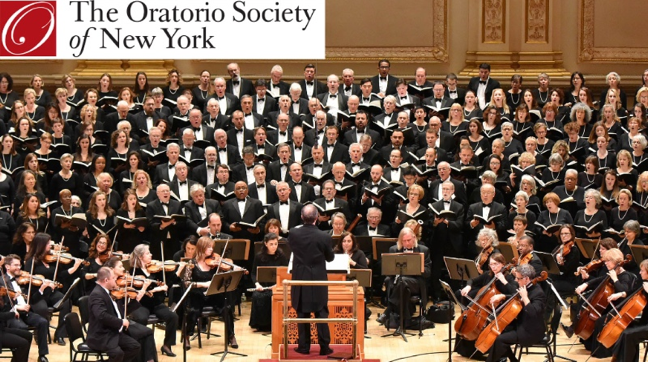
and sing in various choirs including the Oratorio Society of New York---but
have given up sailing small boats and wind-surfing for tamer pursuits.
That's it on this page, for paragraphs about
"I" and "me" and "my." To
conclude with some links and a few pictures:
curriculum vitae giving details of my publications, etc.
a video concerning claims of a small nuclear explosion in North Korea:
https://www.youtube.com/watch?v=vPRJ8lPNSbo&feature=youtu.be
(in 2017, with colleagues, I published a paper arguing that the event was a
very very small earthquake)
a video on "Seismic Monitoring for Hundreds of Earthquakes per
Day, and for the Occasional Nuclear Explosion" https://www.youtube.com/watch?v=_qrj-PyKb8c
a link to Aki/Richards second edition
_
And then some pictures:
Young Paul (circa 1954) 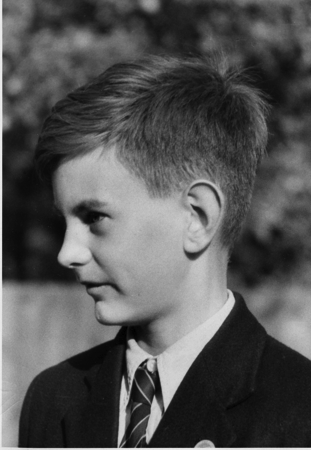
In middle age 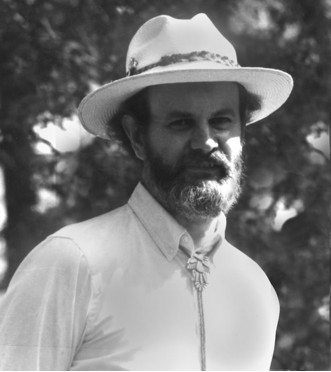
Windsurfing in Kazakhstan at Borovoye in 1991
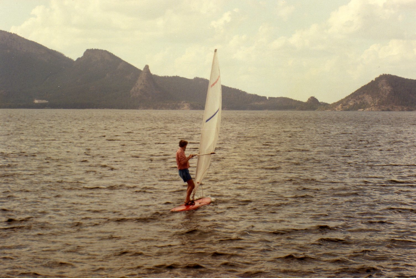
and on the Hudson 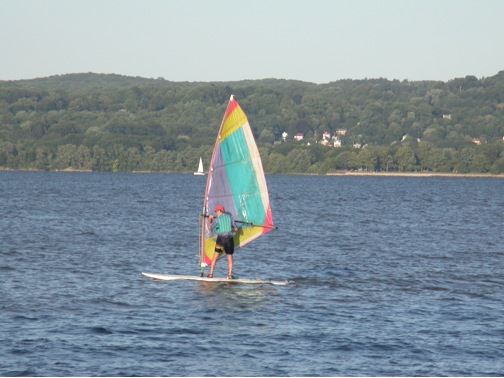
At Grace Church, Nyack, in 1996 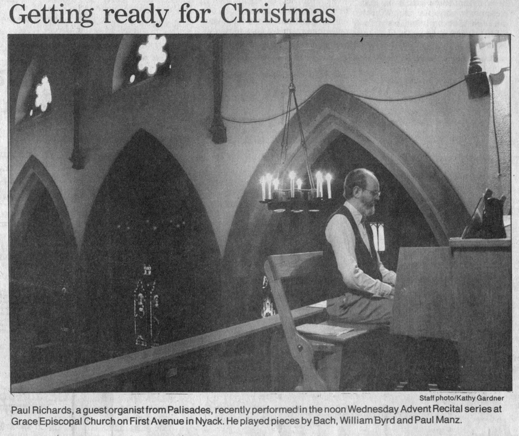
Paul and Jody, at the Barrancas (near Los Alamos, NM) in 1997 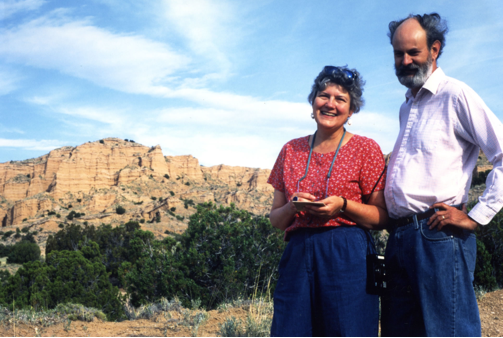
With Mia Leo, singing at a garden party
for newly-married Lynn and Kathy Sykes in 1998 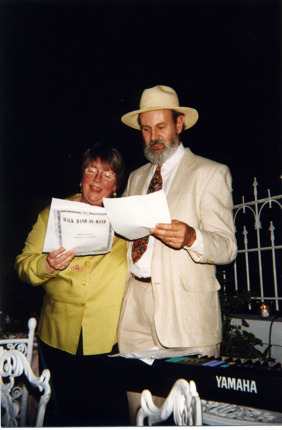
With Kei Aki at the IUGG meeting in
2003
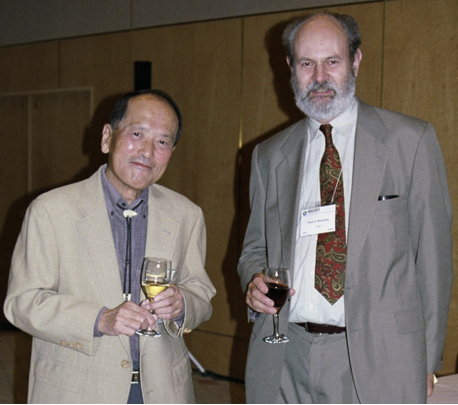
With Jody and Chen Yun-tai (Beijing,
2004) 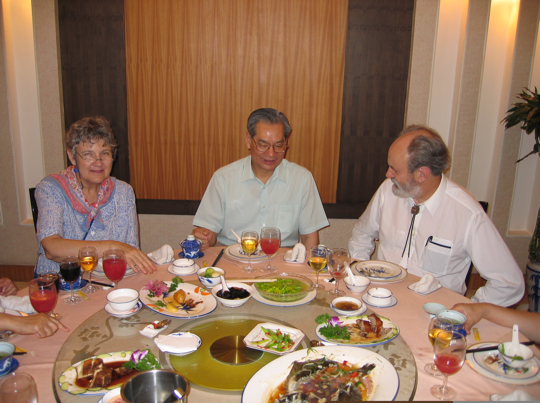
On a panel with Sig Hecker, in Vienna
at a Science &Technology meeting (2011?) 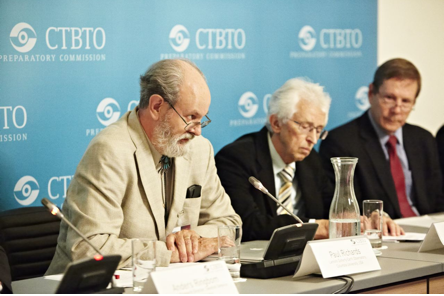
The American Physical Society, awarding
the Szilard Lectureship in 2006 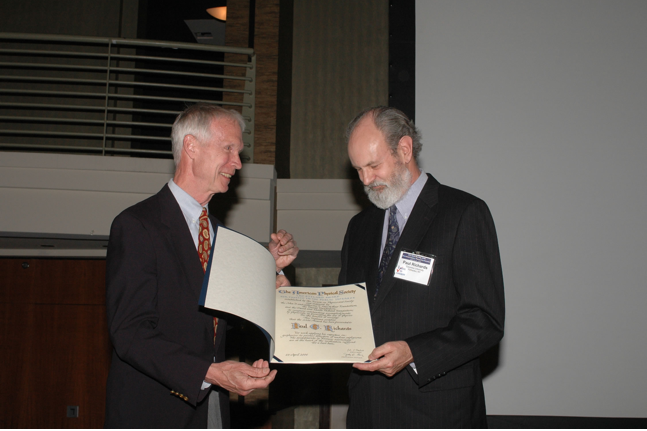
In Vienna, Paul is in the front row and nervously
looking at his notes, since he's to speak right after Mohamed ElBaradei, the DG
of IAEA (at a meeting in September 2006 to celebrate 10 years since the CTBT
was opened for signature---this was the first Science & Technology meeting
sponsored by the CTBTO) 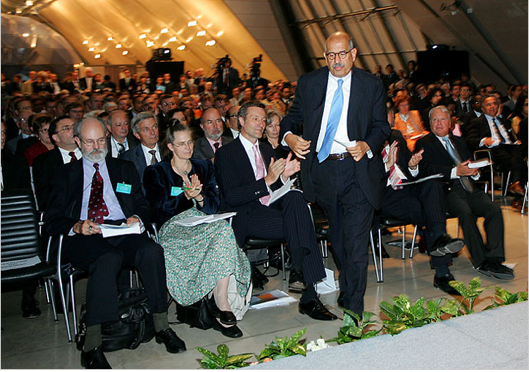
At Columbia College Class Day in
2008 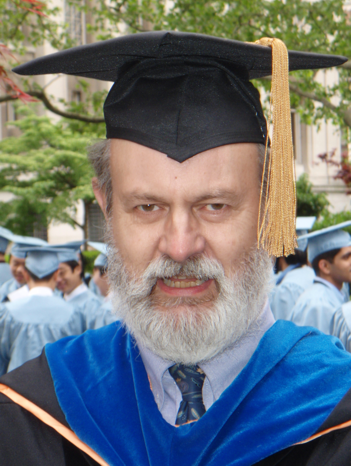
Giving a keynote address in
Vienna (2009) 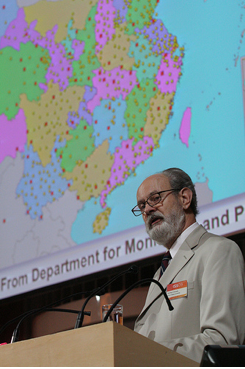
Paul, Jody, Gillian, Leo, Grisha,
and Mark (2012) 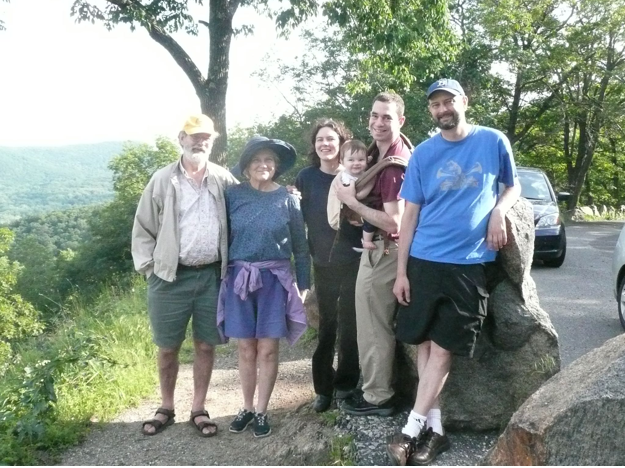
Flying a kite with son-in-law Grisha
and grandson Leo (2013) 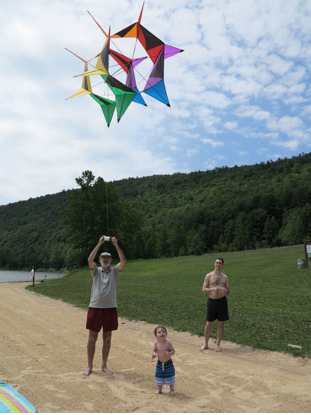
Paul and Jody in Venice (2015) --- the gondolier is
multi-tasking 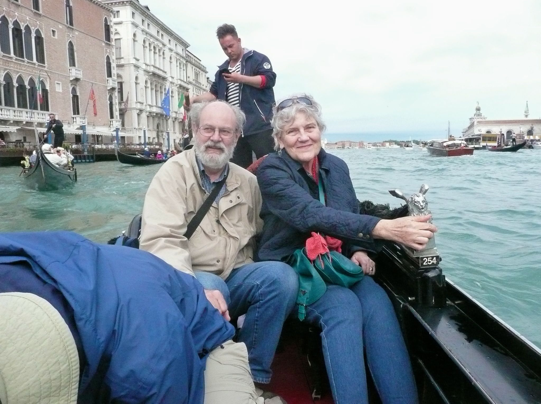
In the back
row at Carnegie Hall (2017)